A Different Kind of Equilibrium
The wellness world promises that balance is achievable — that with the right habits, your body will find its way back to center. But for women navigating chronic illness, that promise can feel like one more thing to fail at. This piece reframes what balance can actually mean for bodies that don't reset on cue.
4/8/2026


In the wellness world, we talk a lot about balance — the body's natural drive to find and return to its own homeostasis.
Work-life balance. Hormone balance. Balanced meals. Balancing rest and productivity.
It sounds beautiful — this promise of steadiness. Of evenness. Of a body and life that return to center.
As I get older, I find myself craving that kind of homeostasis more than ever. A rhythm I can rely on. A sense of predictability. More days spent feeling centered in my body instead of negotiating with it.
But here’s what I actually hate to admit: That advice wasn’t built for bodies like mine. And maybe it wasn’t built for yours either.
Most bodies know how to reset.
You catch a virus. You rest. You recover. You pull a muscle. You heal. You return to baseline. You have a sleepless night and a few days later, you’re back to yourself. There’s a set point. A physiological “normal.” A familiar place the body knows how to come back to.
But when you live with long-term illness, that reset button disappears. There is no reliable baseline waiting on the other side of a flare, a setback, a stressful week, or even a small illness. There is no predictable pathway back to your normal energy — whatever “normal” even means anymore.
Instead, your body is constantly recalibrating. Adjusting. Compensating.
Inconsistency becomes the norm. And when there is no stable baseline, the idea of “balance” starts to feel abstract at best, and impossible at worst.
We Become Experts at Adaptation
When I was starting my business, I asked a friend what he thought I was good at — what I could actually help other people with.
He didn’t hesitate. “You have a high tolerance for pain.”
I laughed. That’s one hell of a marketable skill. But he wasn’t wrong. Living with illness was what I was good at.
People regularly commented on my resilience, my perseverance, and my strength. And I know I’m not alone in that. When you live with ongoing symptoms, you constantly adapt. You move through pain and exhaustion and unpredictable waves of symptoms. You lower expectations, normalize discomfort, and learn how to keep going because life does not pause for your diagnosis.
Adaptability becomes second nature. And in many ways, that’s extraordinary. The body is protective. If we felt the full force of chronic pain or fatigue all at once, it would overwhelm us. So it buffers. It recalibrates. It makes the unbearable livable.
But adaptation has a price. Over time, your “bad days” can sneakily become your regular days. Your healthy standard lowers without you noticing. What once felt alarming becomes tolerable, and what once felt temporary becomes your new normal.
Unlike bodies that return to homeostasis, ours become skilled at surviving without it. And survival, while necessary, is not the same as stability.
The Risk of Living Only in Defense
And survival has another cost that's easy to miss because it happens gradually, almost invisibly. When adaptation becomes automatic, life becomes defensive. You plan around symptoms. You conserve energy. You brace for what might go wrong and organize your world around preventing collapse. In the short term, that's wise — it protects you.
But if every decision is shaped by avoiding the next setback, your world can slowly shrink.
This is the part nobody warns you about. Not the illness itself, but the way managing it can quietly pull you away from connection, from meaning, from joy. You're still functioning — maybe even impressively so — but you're living smaller and smaller.
And eventually, careful starts to feel like its own kind of loss — the slow tilt from a life built around illness to one consumed by it.
When Homeostasis Disappears, Resilience Must Be Built
If equilibrium isn’t something our bodies reliably provide, and if survival alone isn’t enough, then we have to cultivate a different kind of steadiness. This is where resilience becomes less about coping or bouncing back and more about reclaiming.
Resilience isn't a static, inborn personality trait. It isn't something you either have or you don't. It is a set of skills we learn and refine over time. This includes skills like staying with inconsistency without spiraling into fear, listening to what your body needs today instead of demanding yesterday's capacity, letting plans flex instead of fracture, and building rest into your rhythm instead of waiting for the crash. It's learning to create small, meaningful moments of connection and joy, even inside limitation.
And yes — if some of that sounds a lot like living in defense, you're paying attention. The skills themselves aren't always different. But the orientation is. Carefulness asks: how do I protect myself or what I have? It is organized around loss. Resilience asks: what am I moving toward? It is oriented towards life.
Resilience is what replaces homeostasis. Not a steady body, but a steadier way of relating to that body so you can experience more of your life, not just your illness.
A Different Kind of Stability
Maybe homeostasis, for us, isn’t a physical return to baseline. Maybe it is a nervous system that isn’t constantly bracing, a flexible mindset, a compassionate inner dialogue. A life that includes illness — but is not entirely organized around it.
We may not get the predictable reset. But we can practice resilience. And over time, that practice can help us maintain our own kind of equilibrium.
✨ Are you trying to care for yourself in a body that no longer responds the way it used to?
Navigating illness can make caring for yourself feel like an uphill battle. Routines that once worked no longer hold the same way. Energy can be unpredictable, and pushing through often comes at a cost. It can leave you feeling exhausted, discouraged, or like you’re falling behind.
I created this guide to help you find a gentler way forward — one that works with your body instead of against it.
Inside, you’ll discover how to create a gentler, more adaptable approach to wellness. One that helps you rebuild trust with your body, reduce guilt around rest and inconsistency, and care for yourself in ways that actually fit your energy and capacity.
Download your free guide and start caring for yourself in a way that truly supports the body you have now.
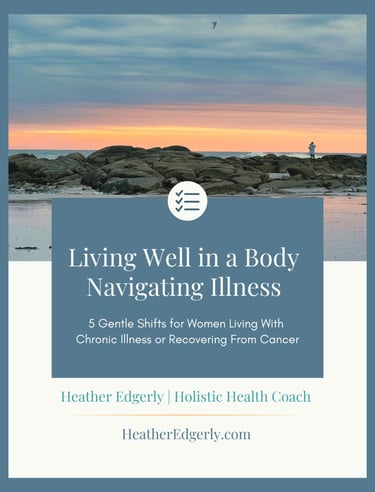
Living Well in a Body Navigating Illness
5 Gentle Shifts for Women Living With Chronic Illness or Recovering From Cancer
Pop your name and email below, and I’ll send the guide straight to your inbox.
Flex With the Body You’re In
A FREE workshop for women navigating illness to live well in a way that honors your energy, your capacity, and your real life
Do you struggle to care for your health when your energy and symptoms keep changing?
Sign Up Now
Join me live on Zoom in a supportive space where you’ll be guided step-by-step to design habits that flex with your body.
Live on Zoom April 21st, 6:00-7:00 PM (EST)
By completing your registration, you agree to the Workshop Terms & Conditions.
This FREE workshop is an invitation to step out of the all-or-nothing cycle and learn a gentler, more sustainable way to care for yourself — one that responds to your body instead of demanding more from it.
This Workshop Is For You If…
You’re navigating an illness that leaves you with unpredictable symptoms and energy
You want habits that support your body on both good days and hard days
You feel stuck in cycles of starting strong, stalling, and starting over
You’re longing for an approach to caring for yourself that feels sustainable

Copyright © 2025. Heather Edgerly. All Rights Reserved. | Privacy Policy | Terms of Use