
Adaptability as a Healing Practice
An exploration of adaptability, healing, and staying in relationship with a changing body.
1/28/2026


I was preparing for a healing movement workshop recently, and the focus was adaptability.
As I was writing and reflecting on what I wanted to share, something became very clear to me.
What I was teaching wasn’t really about movement.
And it wasn’t just about yoga.
It was about healing.
About what it means to live in a body that changes — sometimes gradually, sometimes suddenly — and how we learn to respond when what used to work no longer does.
Adaptability, I realized, isn’t simply a helpful concept for the mat.
It’s a skill that touches every part of the healing experience.
How we move.
How we rest.
How we relate to symptoms, setbacks, and uncertainty.
How we decide when to gently engage — and when to soften and step back.
Over time, adaptability has become the centerpiece of my coaching and my own way of living.
Not as a strategy to optimize healing.
But as a way to stay in relationship with my body — especially when it is a bit disagreeable.
Because healing, I’ve learned, isn’t about forcing ourselves into the shape of who we used to be.
It’s about learning how to meet ourselves where we are — again and again — with responsiveness, care, and trust.
Where This Became Real for Me
I didn’t always understand adaptability this way.
I learned it through yoga — not when my body was strong and bendy, but when illness changed my capacity to move the way I used to.
Suddenly, poses I had practiced for twenty years weren’t available in the same way.
Many days (actually for many years), they weren’t available at all.
And I had a choice.
I could try to force my body to match my memory of it.
Or I could start listening more closely.
Yoga became the place where I had to relearn:
when to gently engage
when to change a pose
when to back off
and when the most skillful option was to do nothing
Not as a failure.
But as part of the practice.
I had to stop competing with a past version of myself —
a version of me my body could no longer be.
Over time, the mat became a microcosm for how I approached the rest of my life.
I stopped asking, “How do I do this the way I used to?”
And started asking, “What is arising in my body right now — and how can I support it?”
That question followed me everywhere.
Into how I planned my days.
Into how I related to symptoms and flare-ups.
Into how I thought about rest, effort, and progress.
Yoga didn’t teach me flexibility.
It taught me adaptability —
the practice of responding instead of forcing,
of meeting limitation with curiosity rather than judgment.
And while yoga was my teacher, the lesson itself isn’t about yoga.
It’s about learning how to live — and heal — in a body that changes.
Adaptability as a Healing Practice
Healing bodies don’t move in straight lines.
What helps one day may be too much the next.
What once felt supportive might suddenly feel draining.
And the pressure to “stay consistent” can quietly turn into self-blame.
Adaptability offers another way.
It asks us to stop forcing our body to meet an idea of what healing should look like —
and instead let our choices evolve based on what our body is asking for today.
Sometimes adaptability looks small:
slowing your pace
taking a pause
choosing the path of least resistance
Sometimes it looks bigger:
changing the plan entirely
resting instead of pushing
completely letting go of something that no longer serves you
Both are part of healing.
Adaptability isn’t about adjusting yourself — it’s about staying in relationship with your body.
It’s about listening.
Listening for the moment you’ve gone a little too far — and honoring that by backing off.
Listening for the moment you feel safe enough to engage just a bit more — and responding to that.
That responsiveness is strength.
That responsiveness is wisdom.
And for many of us, it’s a skill we’re constantly relearning.
An Invitation
As we began to move in that workshop, this is what I invited people to explore —
not perfect shapes, not effort for effort’s sake —but curiosity.
And I invite you to do the same.
Ask yourself:
What does support feel like right now?
What does enough feel like today?
What happens when I let my healing meet me where I am, instead of asking my body to meet an idea?
This is the heart of my work.
Not pushing.
Not fixing.
But listening — again and again — as our bodies change.
And trusting that adapting isn’t giving up.
It’s how we heal.
✨ Are you trying to care for yourself in a body that no longer responds the way it used to?
You’ve been doing your best to show up day in and day out,
even as your energy, symptoms, and capacity shift.
Living with chronic illness or recovering from cancer changes things —
not just physically, but emotionally and mentally too.
🌿 Maybe you’re still measuring yourself by expectations your body can’t meet anymore.
🌫️ Maybe you miss feeling like yourself — not just managing symptoms, but actually living.
💭 Maybe you’re grieving who you used to be while trying to understand who you are now.
This guide offers space to pause and rethink some of these expectations —
and to explore a kinder, more flexible way of relating to your wellness.
No pressure to do more.
No rigid rules to follow.
Just compassionate guidance and permission to design care that fits the body you’re living in now.
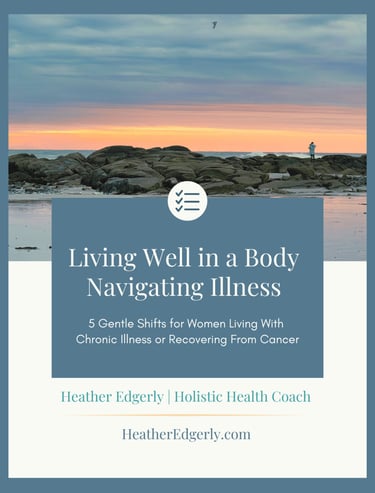
Living Well in a Body Navigating Illness
5 Gentle Shifts for Women Living With Chronic Illness or Recovering From Cancer
Pop your name and email below, and I’ll send the guide straight to your inbox.

Copyright © 2025. Heather Edgerly. All Rights Reserved. | Privacy Policy | Terms of Use