Afraid to Hope? The Hidden Cost of Expecting the Worst
Living with chronic illness or a cancer diagnosis can make hope feel risky. When your brain is wired to expect the worst, protecting yourself can start to feel safer than believing in possibility. Here’s why that instinct makes sense and why hope still matters.
2/24/2026
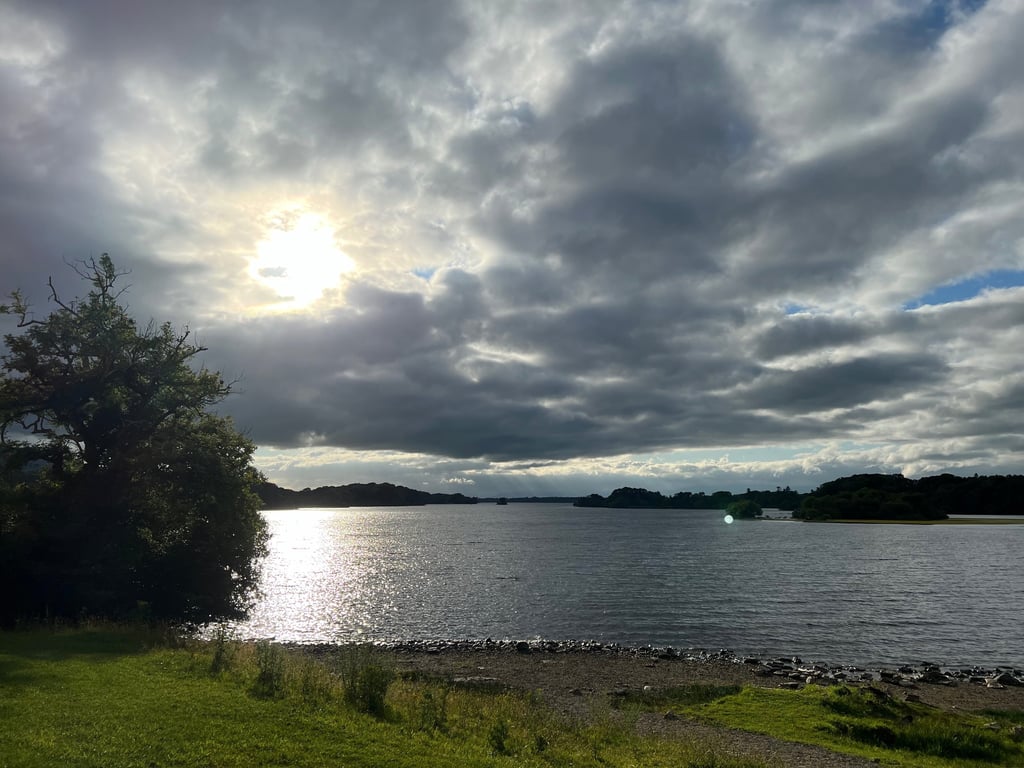
Have you ever noticed how quickly your mind writes the worst possible ending?
How easily it plays that version of the story — over and over again?
And how hard it can feel to let yourself imagine a different one?
Lately, I’ve found myself grappling with hope — and I’m hearing that same struggle echo in conversations with the women I work with.
“I can’t let myself hope this medication or treatment will work.”
“I’m afraid to imagine the best outcome.”
“I’d rather expect the worst than be crushed again.”
If you’ve ever felt that way — especially in the face of well-meaning friends or family telling you to “look on the bright side” — know this:
Hesitating to hope is normal.
It is a form of protection.
When your body has been through illness, side effects, flare-ups, loss, or medical trauma, your survival instinct activates:
Stay alert.
Brace.
Stay informed.
Be prepared for all possible outcomes.
Assume the worst.
It feels safer not to hope.
Because hope requires openness.
And openness feels vulnerable.
So instead, we imagine the worst-case scenario. We tell ourselves we’re being realistic. Prepared. Practical. Ready for anything that might come our way.
But often what’s happening beneath the surface is something far more subtle — and far more taxing.
Our brains are wired with a negativity bias. They scan for danger. They replay threats. They rehearse pain in an attempt to keep us safe.
When we fixate on the worst possible outcome, we don’t just “prepare” for it.
We live it.
We mentally walk through the bad news.
We feel the grief in advance.
We tighten our bodies as if it’s already happening.
Our minds don’t fully distinguish between imagination and reality. They play these “mind movies” — replaying the past, fast-forwarding into countless possible futures — and our nervous system responds as if it’s all unfolding right now.
Heart rate shifts.
Muscles tense.
Energy drains.
We experience that feared future again and again — even if it never arrives.
And that is exhausting. Emotionally and physically.
Hope, on the other hand, is not denial.
It’s not blind faith.
It’s not pretending everything will turn out perfectly.
Hope is the spark of optimism that balances our pessimistic survival brain.
It is the light in the midst of despair.
It doesn’t erase fear — it sits beside it and gently whispers,
“There might be more than one possible ending here.”
Hope reminds us that while our brains are built to protect us, we are not meant to live in constant defense mode.
Survival mode helps us endure.
But it does not help us thrive.
When we lose our relationship with hope, the future collapses into a single dark storyline. One script. One ending. We stop allowing for possibility. We stop allowing for goodness. We stop allowing for surprise.
And something in us dims.
Hope doesn’t promise a cure.
It doesn’t guarantee a specific outcome.
It doesn’t say this will be easy.
What it does say is:
“The future is not known. This negative tale my brain is weaving is only one possibility.”
Hope creates space.
Space to breathe.
Space to experience today without dragging tomorrow’s grief into it.
Space to imagine that something healing, meaningful, or unexpectedly supportive could still unfold — even in the midst of illness. Even in a body that feels uncertain.
It makes sense that your system feels under threat when you're dealing with a serious illness. Your well-being has been shaken to its core. You’ve been through so much.
Of course your brain wants to prepare you.
But you deserve more than just bracing.
You deserve moments of lightness.
Possibility.
A sense that there is still something ahead worth leaning toward.
Maybe hope, for now, is small. Maybe it’s simply this:
“I don’t know how this will go… but I don’t have to live the worst day of my life today.”
Maybe it’s allowing yourself to imagine a glimmer of a positive outcome — not as a guarantee, but as a possibility.
If your mind is going to play movies anyway, you are allowed to let it play one with a hopeful, happy ending too.
Hope doesn’t make you naïve.
It makes you open.
And openness — even in small doses — is what moves us beyond merely surviving and into something more spacious, more alive.
Not because the outcome is certain.
But because there is always more than one story that could unfold.
✨ Are you trying to care for yourself in a body that no longer responds the way it used to?
You’ve been doing your best to show up day in and day out,
even as your energy, symptoms, and capacity shift.
Living with chronic illness or recovering from cancer changes things —
not just physically, but emotionally and mentally too.
🌿 Maybe you’re still measuring yourself by expectations your body can’t meet anymore.
🌫️ Maybe you miss feeling like yourself — not just managing symptoms, but actually living.
💭 Maybe you’re grieving who you used to be while trying to understand who you are now.
This guide offers space to pause and rethink some of these expectations —
and to explore a kinder, more flexible way of relating to your wellness.
No pressure to do more.
No rigid rules to follow.
Just compassionate guidance and permission to design care that fits the body you’re living in now.
Living Well in a Body Navigating Illness
5 Gentle Shifts for Women Living With Chronic Illness or Recovering From Cancer
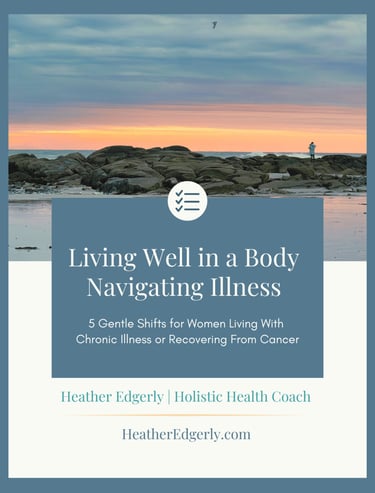
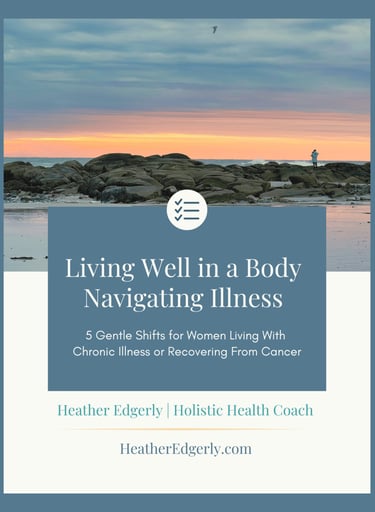
Pop your name and email below, and I’ll send the guide straight to your inbox.

Copyright © 2025. Heather Edgerly. All Rights Reserved. | Privacy Policy | Terms of Use