
Change Your Words, Empower Your Wellness
When chronic illness or cancer recovery already comes with limits, the words we use around wellness matter more than we realize. This reflective piece explores how language shapes our experience and how small shifts in wording can restore a sense of agency, care, and self-trust.
1/5/2026
How often do your wellness choices sound like this: “I can’t…” or “I have to…”?
When you live with chronic illness or are recovering from cancer, your life is already shaped by things you didn’t choose.
Food choices become complex. Movement might need to take on a new form. Energy can disappear without warning. Social plans require calculation. Rest becomes essential, even when the world treats it as optional. Brain fog, pain, and exhaustion exert their influence on every decision.
These are not minor inconveniences. They are daily realities.
And when so much already feels limited, the way we talk about our wellness choices matters more than we realize.
When illness already asks a lot
On my hardest days, pain and exhaustion made even simple things feel impossible. There were stretches where getting off the couch felt like a victory, not a given.
The one thing I did do — almost no matter what — was walk my dog, Kira. And for a long time, the story in my head sounded like this:
“I have to get up.”
“I have to walk her.”
“I have to move.”
On bad days, that language carried resentment. This simple task was just one more demand on a body that was already struggling. (Seriously, Kira… do you really need to poop every day?)
Eventually, something shifted.
I realized that having a dog meant I get to walk her. And that walk — however slow, however short — was one of the few things keeping me moving, getting fresh air, giving me purpose, and staying connected to life outside my pain.
Same action. Completely different experience.
That small language shift didn’t erase the pain — but it softened how I lived inside it.
How supportive choices become framed as restriction
Listen closely to the language that often surrounds wellness:
“I can’t eat that.”
“I can’t hike mountains any longer.”
"I can't make plans like I used to."
“I have to take a nap.”
“I have to take all these pills.”
“I have to eat vegetables.” (A story many of us inherited early on.)
Even when these choices genuinely help your body feel better, the words themselves can make them feel like punishment. Like something is being taken away. Like your body is the enemy.
When life already comes with limits, this kind of language can turn care into confinement.
One more restriction.
One more demand.
The subtle power of changing your words
I’ve seen this pattern show up again and again — especially around food.
When I was living with Crohn’s disease, I was determined to keep my colon. So I tried all the diets.
No sugar.
No gluten.
No carbs.
No dairy.
Low-inflammation diets.
Ayurvedic approaches.
The Specific Carbohydrate Diet.
(At one point I’m pretty sure I was living on air, yogurt, and sheer determination.)
Some of these approaches were incredibly restrictive — and some of them genuinely helped me feel better.
What made the biggest difference wasn’t just what I ate. It was where I put my focus.
Instead of obsessing over the very long list of foods I “couldn’t” have, I started building a list of foods I could eat. Foods I actually enjoyed. Meals that tasted good.
I let creativity guide me instead of deprivation. I even started writing an SCD cookbook that now lives somewhere on my hard drive — a relic of both desperation and hope.
That shift — from “I can’t” to “what can I have?” — gave me back a sense of agency in a situation that already felt out of my control.
When people asked (which was often), I stopped answering from restriction.
Instead of explaining what I couldn’t eat, I began saying:
“I don’t eat that right now.” or "I feel better when I don't eat that."
Same reality.
Very different energy.
Why this shift is empowering rather than performative
When your illness has already taken so much from you, language can either reinforce powerlessness or help you reclaim a sense of self-trust. A sense of empowerment.
“I can’t” often lands as final and absolute. “I don’t” and “I choose” acknowledge reality and agency at the same time.
This isn’t toxic positivity. It doesn’t erase grief or magically make things easier.
Declaring "I don't eat bread" isn't suddenly going to fix everything.
It simply keeps necessary care from becoming another way you feel trapped by your circumstances.
Let wellness feel supportive again
If your wellness routines feel oppressive, it may not be because you’re doing them wrong. It may be because the words surrounding them feel unforgiving.
You’re allowed to care for your health without framing it as loss.
You’re allowed to honor your limits without turning them into a cage.
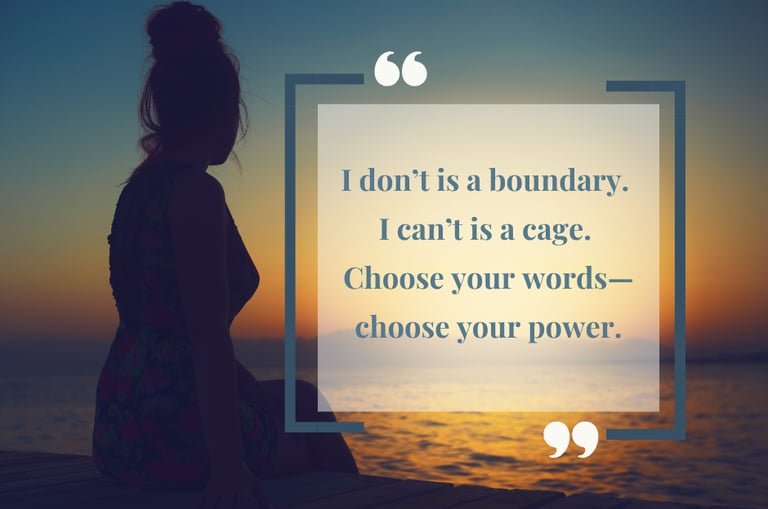
“I don’t is a boundary. I can’t is a cage. Choose your words. Choose your power.”
A simple practice
Take a moment to write down one way you can reframe a wellness choice — from something that feels like it happened to you into language that empowers how you care for your health.
This isn’t about doing more. It’s about speaking to yourself with the same care you’re already trying to give your body.
As the year continues to unfold, may your words become one more way you care for yourself — gently, honestly, and on your own terms.
✨ Are you trying to keep up with life in a body that doesn’t always keep up with you?
You’ve been showing up, adapting, and doing your best to care for yourself,
even when your energy or symptoms make that harder than it should be.
But living in a body that’s healing, unpredictable, or just plain tired takes its toll.
💤 Maybe you’re struggling to maintain healthy routines that fit your needs.
🌥️ Maybe joy feels muted or hard to reach.
🧭 Maybe your body and mind feel out of sync.
This short self-check is your opportunity to reveal where you might need the most support, so you can begin making small, meaningful changes that work with your body, not against it.
No pressure. No judgment. Just space to listen, a little compassion, and clarity about what your body and mind are asking for.
Pop your name and email below, and I’ll send the quiz straight to your inbox.
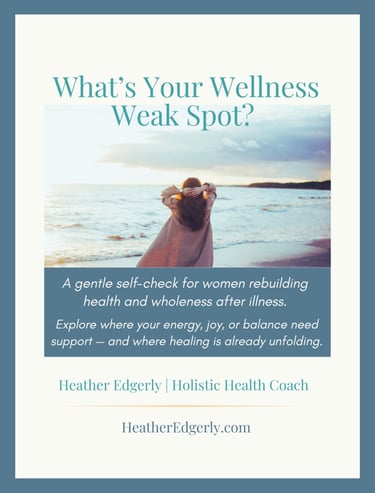
What’s Your Wellness Weak Spot?
Use this quick self-check to uncover where help you explore where your energy, joy, or balance need more support.

Copyright © 2025. Heather Edgerly. All Rights Reserved. | Privacy Policy | Terms of Use