
Journaling as an Act of Healing
Journaling can be so much more than simply writing down your thoughts. In this post, I explore how a simple reflective practice can help us process difficult emotions, shift our attention away from negativity, and reconnect with the small moments of goodness that often go unnoticed. If you’ve ever felt overwhelmed, stuck in your own head, or unsure where to begin with journaling, this gentle approach might be exactly what you need.
5/20/2026


Journaling can take many different forms, and there is no “right” way to do it. Some people fill pages every day. Some write lists. Some jot down a few thoughts before bed. Some write only when life feels especially overwhelming.
If you do not already have a journaling practice, it can be a really powerful tool for healing.
Not because you need to become a writer. Not because every thought needs to be deep or meaningful. But because writing things down helps us process what we are going through instead of holding it all in our heads and bodies.
Sometimes journaling helps us work through hard moments when challenges arise. It gives us a space to dump out anxieties, fears, frustrations, and all the mental clutter we carry around. Sometimes it helps us find words for feelings we cannot quite pinpoint. Sometimes it simply helps us pause long enough to check in with our bodies and minds and notice how we are doing.
Although journaling is great for processing the challenging stuff, it can be a powerful tool for bringing attention to the good stuff too. The moments of connection, celebration, joy, kindness, and even the ordinary pleasant things that happen every day. Those things that tend to skedaddle right out of our brains without recognition.
Over time, journaling becomes a record of your life. A place where you can look back and see your growth, your resilience, your healing, and all the small moments of goodness that could have been so easily lost to memory (especially if you have a foggy menopausal brain like mine).
Journaling and Balancing the Negativity Bias
Our brains naturally focus on negativity. It is part of being human. In Positive Psychology, this is called the negativity bias. We are wired to notice problems, stress, fear, and discomfort because our brains are always trying to keep us safe. But when we stay stuck there too long, it can start to feel like the hard things are all there is.
The bad stuff begins to dominate our attention, making it harder to notice what is still good, hopeful, or meaningful. We get trapped in a negativity loop where our illness becomes the center of our experience. All the while strengthening the brain pathways that fixate on the bad stuff (as if we needed any help). We can easily slip into a mode of viewing the world through the prism of our suffering.
Journaling is one tool that can help bring balance to that.
It gives us a place to work through what is painful while also helping us redirect our attention toward the good things that still exist alongside the hard ones. Over time, this can help us feel more resilient and more grounded in our day-to-day lives. As a bonus, the more we practice noticing the positive things, the more our brains start looking for them too.
A Simple Structure
For me, journaling has become a daily grounding practice. I usually do it in the morning, but this could easily be something you do at the end of the day too.
When you’re anxious or fearful, getting your thoughts out before bed can help quiet the mental noise and make space for rest. I call this “doom journaling” — that word-vomit style of writing where you scribble everything down just to give your brain some freedom to rest.
And the beautiful thing is that it does not have to take long. This can be a five-minute practice. It does not need to be perfect. You do not need a fancy notebook. You don’t need to channel Leonard Cohen and rack your brain for profound insights.
You just need a little honesty and a little space to reflect.
The structure I use is very simple, and for the life of me I cannot remember where I first learned it, so I apologize for not giving proper credit. Thank you whoever you are!
Prompt 1: I will focus on…
This is where you can set your intention for the day. Sometimes this focus might be practical. For me that might be starting to write a blog post or tackle a task I have been avoiding for way too long. (I see you, license renewal postcard.)
Other times your focus might be more about how you want to move through the day. Perhaps that is being more patient, inviting in more joy, or being more present with the people around you.
Your focus for the day does not need to be rigid or formal. It is simply a way of gently directing your attention and then holding that goal lightly.
Prompt 2: I will let go of…
What are you carrying right now that you are ready to loosen your grip on?
Maybe it is fear.
Maybe it is anger.
Maybe it is perfectionism.
Maybe it is comparing yourself to other people.
Maybe it is the constant pressure to do more, be more, or have everything figured out.
Some days the thing I most want to let go of is my to-do list – to tear it up and toss it into the fire.
This prompt can be powerful. We often don’t realize how much space certain thoughts or emotions are taking up until we finally slow down enough to acknowledge them. Only then can we begin the process of letting go.
Prompt 3: I am grateful for…
Gratitude practices are beneficial because they help retrain our attention from lack to abundance. The more we practice noticing goodness, joy, and enoughness, the easier it becomes to see it.
And I think it helps to get specific here.
Of course we are grateful for our loved ones, our homes, our pets, and perhaps our jobs. But sometimes it is the smaller things that really shift us back into the present moment.
The sun finally coming out after days of rain.
A meaningful conversation.
A delightful cup of coffee.
A moment where your body felt a little stronger than it did yesterday.
These moments matter.
Prompt 4: Wins & Other Good Stuff
This final prompt is a bonus section that I recently added into my own practice. It overlaps a little with gratitude, but I think it deserves its own space.
Sometimes your wins are big. Maybe you reached a milestone in your healing journey. Last week, I received a reminder on my phone that I am officially five years cancer-free. Maybe the cancer center rang that bell for you, or you’ve finally gone into remission, or you accomplished something you worked really hard for.
But most often the win is simply that you kept going.
You made it to yoga class.
You drank that whole liter of water.
You picked up the phone to chat with a friend even though you were tired.
You completed a project at work.
And then there is the “other good stuff” category — the tiny moments that make up a life but are so easy to forget.
Your partner made you a cup of coffee.
You saw a hummingbird feeding outside your window.
You listened to the dog snoring beside you.
You took a much-needed nap and woke up refreshed.
You ate takeout from your favorite Thai place.
These small things add up over time, and writing them down matters.
Because when we are struggling, it can become very hard to see our own progress and the beauty available to us in our day-to-day lives.
That is one of the most beautiful things about journaling. Over time, your journal becomes proof. Proof that there were good moments too. Proof that you have grown. Proof that you have healed. Proof that the struggle was never the whole story.
If you want to try this practice for yourself, it can be as simple as writing down these four prompts:
I will focus on…
I will let go of…
I am grateful for…
Wins & Other Good Stuff
That’s it. Five quiet minutes. A notebook. A few honest reflections.
✨ Are you trying to care for yourself in a body that no longer responds the way it used to?
Navigating illness can make caring for yourself feel like an uphill battle. Routines that once worked no longer hold the same way. Energy can be unpredictable, and pushing through often comes at a cost. It can leave you feeling exhausted, discouraged, or like you’re falling behind.
I created this guide to help you find a gentler way forward — one that works with your body instead of against it.
Inside, you’ll discover how to create a gentler, more adaptable approach to wellness. One that helps you rebuild trust with your body, reduce guilt around rest and inconsistency, and care for yourself in ways that actually fit your energy and capacity.
Download your free guide and start caring for yourself in a way that truly supports the body you have now.
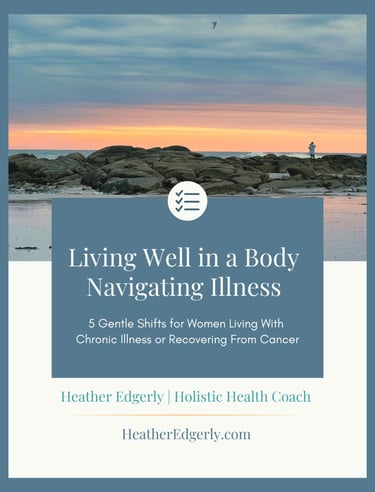
Living Well in a Body Navigating Illness
5 Gentle Shifts for Women Living With Chronic Illness or Recovering From Cancer
Pop your name and email below, and I’ll send the guide straight to your inbox.
Flex With the Body You’re In
A FREE workshop for women navigating illness to live well in a way that honors your energy, your capacity, and your real life
Do you struggle to care for your health when your energy and symptoms keep changing?
Sign Up Now
Join me live on Zoom in a supportive space where you’ll be guided step-by-step to design habits that flex with your body.
Live on Zoom April 21st, 6:00-7:00 PM (EST)
By completing your registration, you agree to the Workshop Terms & Conditions.
This FREE workshop is an invitation to step out of the all-or-nothing cycle and learn a gentler, more sustainable way to care for yourself — one that responds to your body instead of demanding more from it.
This Workshop Is For You If…
You’re navigating an illness that leaves you with unpredictable symptoms and energy
You want habits that support your body on both good days and hard days
You feel stuck in cycles of starting strong, stalling, and starting over
You’re longing for an approach to caring for yourself that feels sustainable

Copyright © 2025. Heather Edgerly. All Rights Reserved. | Privacy Policy | Terms of Use