When Life Doesn’t Match the Plan: Learning to Live in the Gap
What do you do when chronic illness changes the shape of your life in ways you didn’t expect? When you find yourself somewhere between where you are and where you hoped to be? This is a reflection on navigating that space and finding your way back to what still matters.
5/5/2026

Many of us find ourselves living a life that doesn’t look the way we thought it would.
Sometimes everything gets shifted—your energy, your identity, your relationships, your sense of what’s possible. And before you even fully realize it, you’re living in a space that feels unfamiliar… somewhere between the life you imagined and the one you’re actually in.
And no one really teaches you how to live there.
Not in the in-between. Not in the version of life—or the version of you—that doesn’t match what you expected or hoped for.
We all experience some variation of this. There’s almost always a gap between where we are and where we thought we’d be. Between the life we’re living and the one we had in mind.
At times, that gap can even be useful. It can give us motivation, something to move toward, something to build, something to hope for.
But when you’re living with chronic illness, that space can feel very different.
It’s not just about goals or aspirations or timelines anymore. It’s the gap between how your body feels today and how you wish it could feel. Between having energy and feeling completely depleted. Between the version of you that once felt familiar and the one you’re still learning how to live with now.
And over time, that gap can start to feel like the place where all of your attention lives.
It’s where your thoughts go when things are quiet.
It’s where comparison creeps in.
It’s where “maybe someday” starts to hold more possibility than today.
You might find yourself thinking, I’ll feel better when things change. Or, life will be good again once I get there—wherever “there” ends up being… after treatment, in remission, when things finally feel more stable.
And without even meaning to, your life starts to feel like something that’s on hold. Like you’re stuck in between what was and what you hope might come next.
Especially when there’s no clear way forward. No simple fix. No timeline you can rely on. Just the ongoing reality of living in a complicated, unpredictable body.
So the question becomes: how do you live here?
Really live here.
Not just survive. Not just exist. Not just push through or cope. But actually live in this in-between space.
Because sometimes there are small steps available that move you forward. Accessible ways to support your well-being. Tiny shifts that help you feel a little more at ease, a little stronger, a little happier, a little more connected.
But other times, there isn’t a clear path that leads you out of the gap. There isn’t something you can tweak, fix, or solve right now.
And in those moments, a different kind of approach opens up.
Not giving up, but softening your grip on how things were “supposed” to be.
This is where acceptance begins to take shape—not as resignation, and not as pretending things are okay when they’re not—but as a way of creating just enough space to stop fighting reality every second of the day.
Because when all of your energy is tied up in trying to close the gap, there’s very little left for actually living your life.
And this is where something new can begin—not by changing your circumstances, but by shifting your focus.
Intentionally moving away from ruminating on what’s missing or how things should be…
and beginning to turn toward what still matters to you.
Letting yourself ask: What truly matters to me? What do I value?
Not in the life you imagined.
Not in some future version where everything feels better.
But in the life you’re in right now.
Maybe it’s peace.
Maybe it’s freedom.
Maybe it’s love, or learning, or purpose, or creativity, or joy.
Those things don’t require perfect circumstances. They don’t require a symptom-free body or a fully predictable life. But they do ask for your attention. Your presence. Your willingness to let them exist alongside the hard parts.
Peace might look like carving out ten minutes to watch the sky and become fascinated by the movement of the clouds.
Freedom might look like saying yes to an opportunity to be spontaneous when your body allows.
Creativity might look like spending time writing or drawing or making music.
Not all the time. Not perfectly. Not with any particular end goal. But in small moments that begin to add up—allowing you to live a life aligned with your values, right now.
Because your life isn’t waiting for you on the other side of the gap.
It’s here. In the middle of it. In the days that don’t go to plan. On the path of healing. In each and every moment.
And maybe that’s the shift.
Maybe the goal isn’t to close the gap. (We all know that gap never really closes).
Maybe it’s to learn how to live inside it.
To stop holding your breath until things are different. To stop ruminating about how you wish things were. To stop treating your days as something you just have to get through.
And instead, to begin to be part of your life as it is.
Because this is still your life. And you are still you.
And even here in these undesirable circumstances, there is space to find fulfilment. To pursue meaning. To feel love. To experience joy. To be free.
Not because everything is perfect, but because nothing ever truly is. And you’re allowing yourself to live and even grow within the imperfection.
So wherever you find yourself right now—in the in-between, in the uncertainty, in a version of life you didn’t plan for—
you’re not in suspended animation.
You’re right in the middle of your beautiful, messy life.
And there is space, even in this gap, to be fully you—
to shape your life around what you value, even in the smallest of ways.
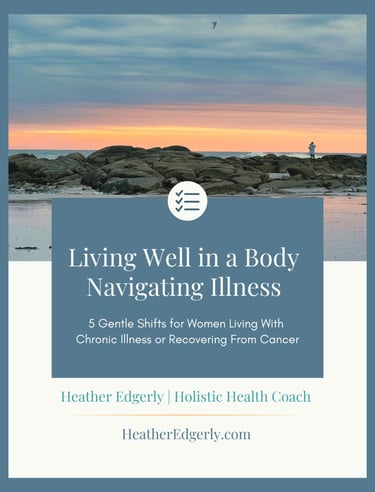
✨ Are you trying to care for yourself in a body that no longer responds the way it used to?
Navigating illness can make caring for yourself feel like an uphill battle. Routines that once worked no longer hold the same way. Energy can be unpredictable, and pushing through often comes at a cost. It can leave you feeling exhausted, discouraged, or like you’re falling behind.
I created this guide to help you find a gentler way forward — one that works with your body instead of against it.
Inside, you’ll discover how to create a gentler, more adaptable approach to wellness. One that helps you rebuild trust with your body, reduce guilt around rest and inconsistency, and care for yourself in ways that actually fit your energy and capacity.
Download your free guide and start caring for yourself in a way that truly supports the body you have now.
Living Well in a Body Navigating Illness
5 Gentle Shifts for Women Living With Chronic Illness or Recovering From Cancer
Pop your name and email below, and I’ll send the guide straight to your inbox.
Flex With the Body You’re In
A FREE workshop for women navigating illness to live well in a way that honors your energy, your capacity, and your real life
Do you struggle to care for your health when your energy and symptoms keep changing?
Sign Up Now
Join me live on Zoom in a supportive space where you’ll be guided step-by-step to design habits that flex with your body.
Live on Zoom April 21st, 6:00-7:00 PM (EST)
By completing your registration, you agree to the Workshop Terms & Conditions.
This FREE workshop is an invitation to step out of the all-or-nothing cycle and learn a gentler, more sustainable way to care for yourself — one that responds to your body instead of demanding more from it.
This Workshop Is For You If…
You’re navigating an illness that leaves you with unpredictable symptoms and energy
You want habits that support your body on both good days and hard days
You feel stuck in cycles of starting strong, stalling, and starting over
You’re longing for an approach to caring for yourself that feels sustainable

Copyright © 2025. Heather Edgerly. All Rights Reserved. | Privacy Policy | Terms of Use