
When No One Can See What You Carry: The Invisible Weight of Chronic Illness
When you live with chronic illness long enough, it can start to become invisible. This piece explores what it feels like when your struggles go unseen and why that can feel so isolating.
5/13/2026


There’s a part of living with chronic illness that no one really prepares you for. It’s how invisible it becomes.
When you’re in a crisis, like a hospitalization or new cancer diagnosis, people tend to show up. They hold your hand, offer support, and create a sense of being cared for. In those moments, your experience is seen and acknowledged.
But when your illness is chronic or ongoing, things tend to shift.
It is not because people stop caring. It is because your illness does not follow a clear or visible storyline. It doesn’t begin and end in a way that people can easily understand. It isn’t an isolated crisis, healing, back to normal…the end.
Instead, it continues.
Maybe you experience a flare, feel a bit better for a while, and then another one returns. Or cancer treatment ends and people celebrate, relieved that it’s “over,” while you’re left managing the side effects for years to come.
It becomes a pattern that is hard to understand from the outside.
I remember visiting my family one summer and someone saying, “You’re sick again?”
I remember being flabbergasted. My first thought was no, I’m not sick again. I’m still sick.
I’d been sick for a decade.
The magnitude and persistence of my Crohn’s disease wasn’t something people could comprehend. The ways it affected not only my digestion, but my immune system. How it evolved into rheumatoid arthritis and impacted my ability to move freely. How it disrupted my sleep and left me chronically exhausted.
How eating the “wrong” thing could send me into a spiral for days, and sometimes even the “right” thing could do the same. How it drained my time, energy, and resources just to get through each day.
There was no clear end in sight. No simple resolution. No magical cure.
Long-term illness isn’t something that you can truly understand unless you live it.
When you become “good” at being sick
When you live this way long enough, you start to adapt.
At first, it might be conscious. You push through when you can. You cancel plans when you need to. You try to manage symptoms in a way that lets you keep participating in your life.
But over time, it becomes second nature.
You learn how to make your illness less noticeable. You learn how to keep things moving without drawing attention to what is actually happening in your body.
You become so adept at masking that your suffering becomes unseeable.
It’s a magic trick. A kind of illusion. The outer version of you no longer matches what’s happening inside.
I read a quote recently that said:
“When you’re a good swimmer, people don’t know when you’re drowning.”
From the outside, it can look like you are managing just fine. You are still showing up. You are still functioning.
But underneath, your body may be working incredibly hard just to get through the day. I had a boss once who described it as being like a duck on the water. From the surface, everything looks calm and steady, but underneath, the legs are kicking furiously just to stay afloat.
Eventually, you become so practiced at this that you do not even realize you are doing it anymore.
The disconnection that follows
When something is not visible, it often stops being part of the conversation. You don’t want to center all conversations around your illness. And over time, fewer people ask.
Perhaps they assume you are doing better. They may not want to say the wrong thing. Sometimes they feel like their own struggles are not as significant, so they hold back.
And so the conversations stay light. Surface-level. Easier.
Meanwhile, your reality is much more complex.
You’re navigating symptoms that shift without warning. You’re exhausted. There are limitations that other people can’t see, but that affect nearly every decision you make.
What you eat. Where you go. How long you stay. What you spend your money on. What your body can tolerate.
All of it requires thought, energy, and constant adjustment.
Over time, this can create a subtle but painful distance.
You are close enough to be part of things, but not always able to fully participate.
It can feel like standing on the edge of your own life, peeking through a window. Watching from the sidelines as people celebrate milestones, go on adventures, and move through their lives without wondering if their bodies will keep up.
The loneliness inside the invisibility
At its core, this isn’t just about illness. It is about our fundamental human need for connection.
We all want to feel seen. To feel understood. To feel like we belong.
When those needs aren’t met consistently, especially over time, it can turn into a very particular kind of loneliness.
Not necessarily being alone…
but not fully being seen.
You might stop explaining because it feels like too much effort. You might minimize what you are going through so that it feels easier for others to hear. You might carry more on your own because it feels simpler than trying to be understood.
You are not alone
If you recognize yourself in any of this, it makes sense.
The invisibility, the adaptation, the disconnection, the loneliness. These are all natural responses to living in a body that asks more of you than most people can see.
But you are not the only one living this way.
There are many of us navigating the same fears and uncertainties. Carrying things that don’t always have a place in conversation.
And while it may not change the invisibility…
maybe it softens it, just a little, to remember this:
you are not alone on this path.
✨ Are you trying to care for yourself in a body that no longer responds the way it used to?
Navigating illness can make caring for yourself feel like an uphill battle. Routines that once worked no longer hold the same way. Energy can be unpredictable, and pushing through often comes at a cost. It can leave you feeling exhausted, discouraged, or like you’re falling behind.
I created this guide to help you find a gentler way forward — one that works with your body instead of against it.
Inside, you’ll discover how to create a gentler, more adaptable approach to wellness. One that helps you rebuild trust with your body, reduce guilt around rest and inconsistency, and care for yourself in ways that actually fit your energy and capacity.
Download your free guide and start caring for yourself in a way that truly supports the body you have now.
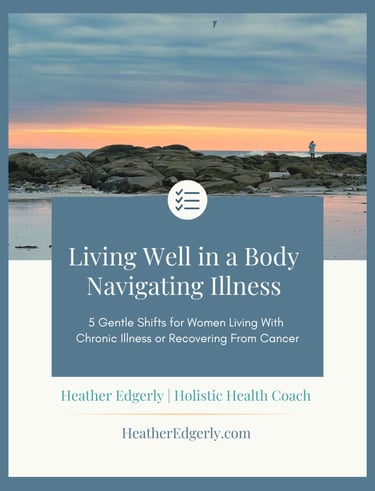
Living Well in a Body Navigating Illness
5 Gentle Shifts for Women Living With Chronic Illness or Recovering From Cancer
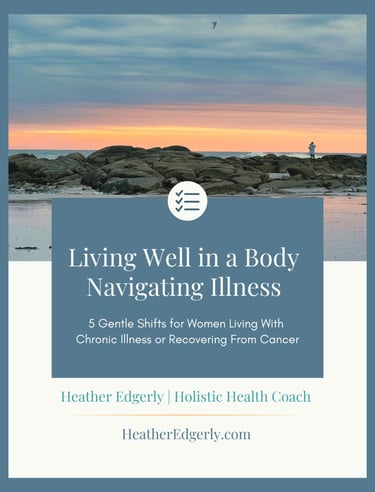
Pop your name and email below, and I’ll send the guide straight to your inbox.
Flex With the Body You’re In
A FREE workshop for women navigating illness to live well in a way that honors your energy, your capacity, and your real life
Do you struggle to care for your health when your energy and symptoms keep changing?
Sign Up Now
Join me live on Zoom in a supportive space where you’ll be guided step-by-step to design habits that flex with your body.
Live on Zoom April 21st, 6:00-7:00 PM (EST)
By completing your registration, you agree to the Workshop Terms & Conditions.
This FREE workshop is an invitation to step out of the all-or-nothing cycle and learn a gentler, more sustainable way to care for yourself — one that responds to your body instead of demanding more from it.
This Workshop Is For You If…
You’re navigating an illness that leaves you with unpredictable symptoms and energy
You want habits that support your body on both good days and hard days
You feel stuck in cycles of starting strong, stalling, and starting over
You’re longing for an approach to caring for yourself that feels sustainable

Copyright © 2025. Heather Edgerly. All Rights Reserved. | Privacy Policy | Terms of Use